
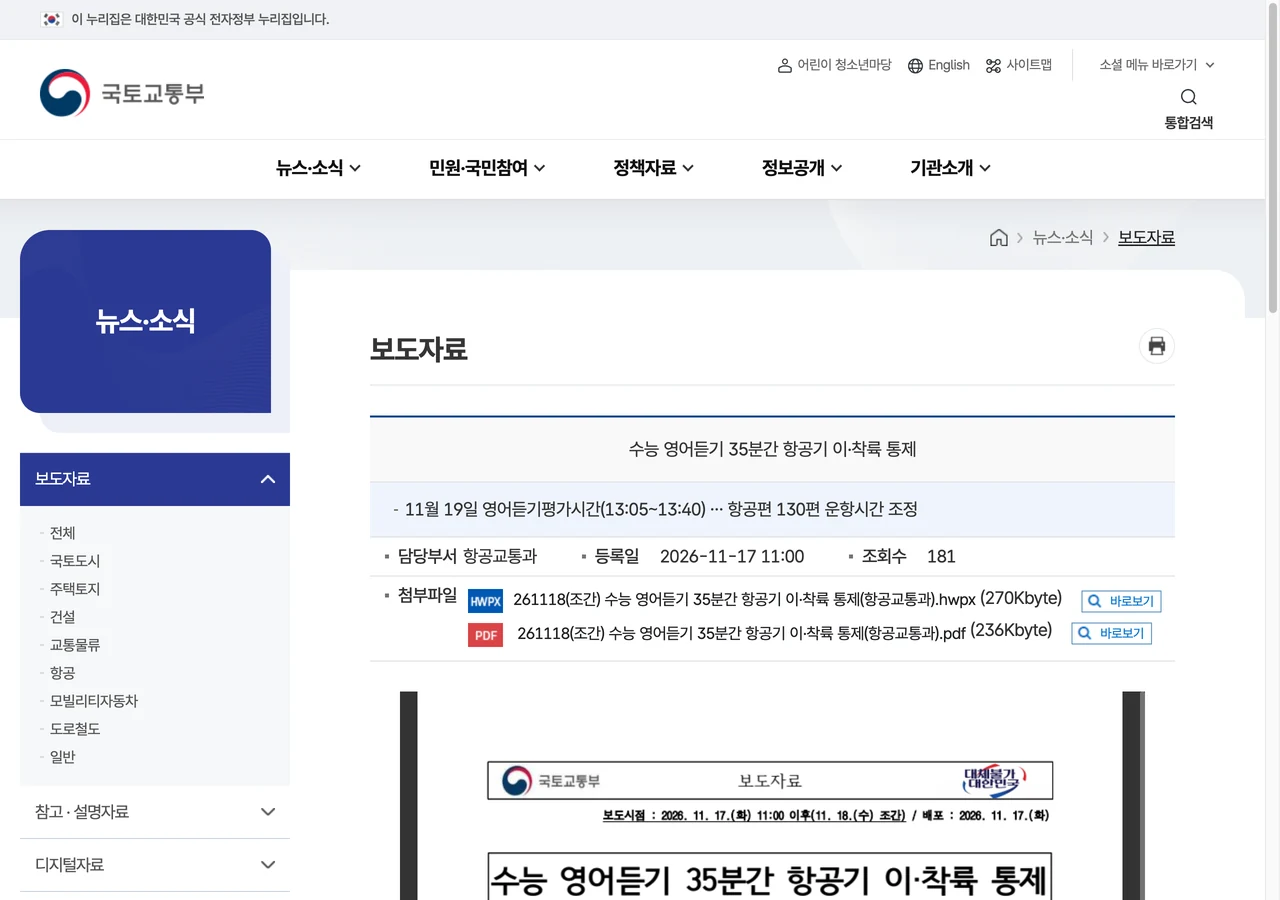
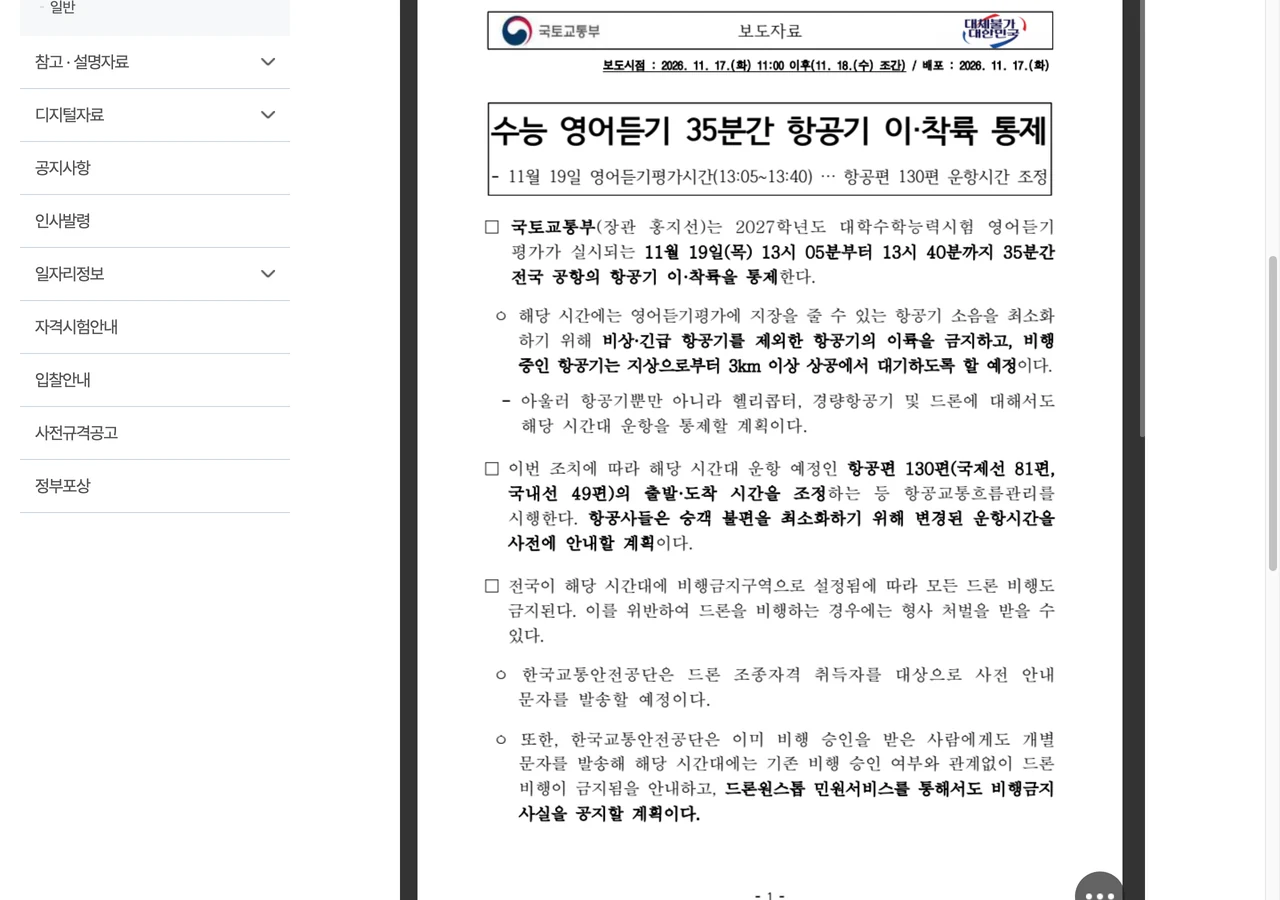
South Korea’s Ministry of Land, Infrastructure and Transport (MOLIT) announced on November 17, 2026, that all aircraft takeoffs and landings across every airport in the country will be suspended for 35 minutes on Thursday, November 19, from 13:05 to 13:40 KST during the English listening section of the annual College Scholastic Ability Test (Suneung). Under this nationwide air traffic flow measure, a total of 130 flights—81 international and 49 domestic—have had their departure or arrival times adjusted. All non-emergency takeoffs are prohibited during the window, airborne aircraft must hold at altitudes of 3 kilometers (approx. 9,840 feet) or higher, and helicopters, ultralight aircraft, and all drones are banned nationwide without exception. MOLIT Official Press Release (Korean)
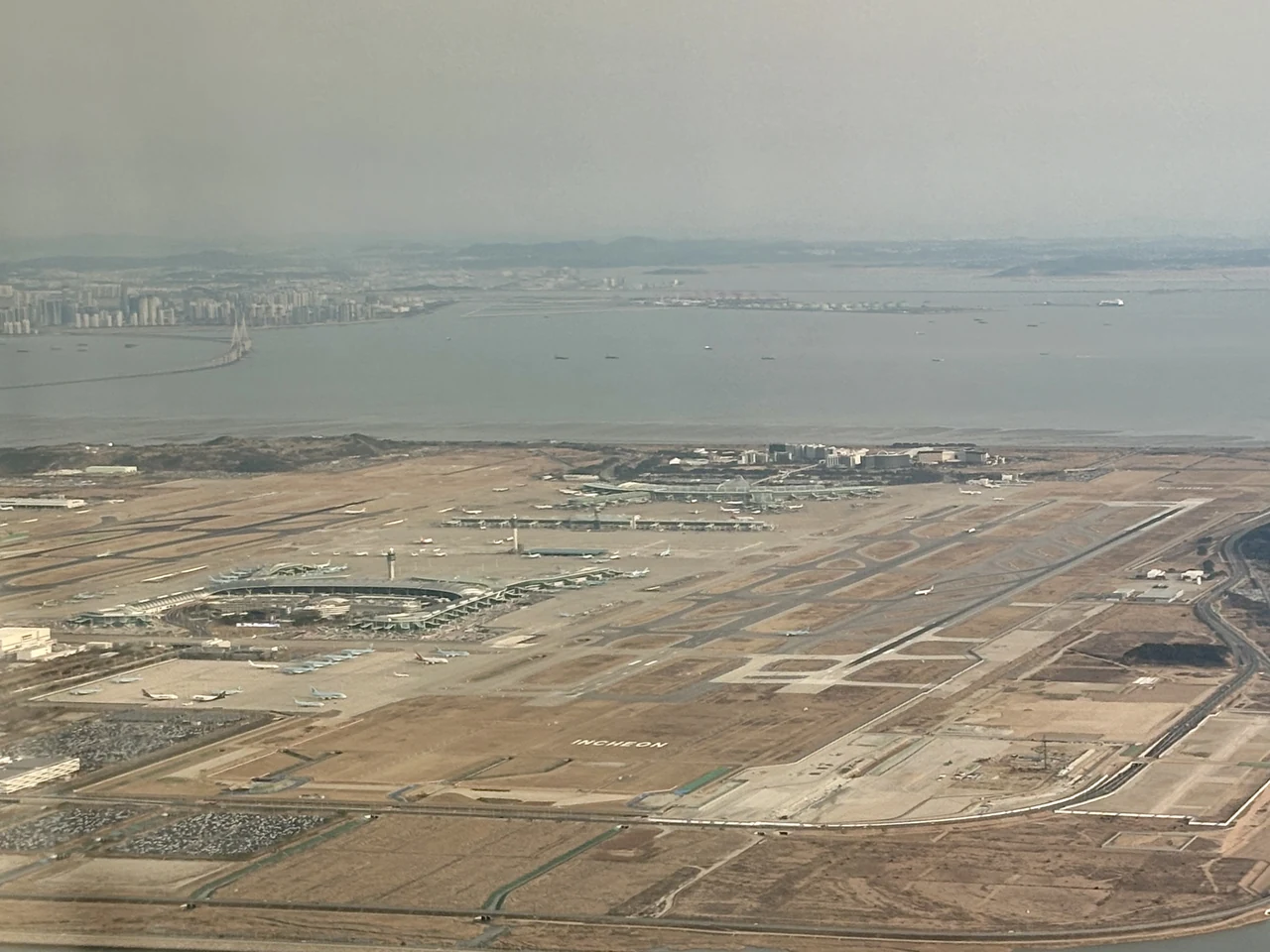
November 19 Airspace Control Window and Flight Adjustments
To prevent aircraft noise from disrupting test-takers nationwide, MOLIT, air traffic control authorities, Incheon International Airport Corporation (IIAC), and Korea Airports Corporation (KAC) are enforcing the following restrictions across all South Korean airports and airspace.
| Item | Official Control Measures |
|---|---|
| Restriction Window | Thursday, November 19, 2026, 13:05 – 13:40 KST (35 minutes) |
| Geographic Scope | All South Korean airports and nationwide airspace |
| Rescheduled Flights | 130 flights total (81 international + 49 domestic) |
| Ground Operations | All takeoffs prohibited except emergency and urgent aircraft |
| Airborne Holding | En-route aircraft held at 3 km or higher above ground |
| Other Aircraft & Drones | Helicopters, ultralights, and all drones prohibited (including pre-approved flights) |
- Ripple Delays Around the 35-Minute Window: While the formal halt runs from 13:05 to 13:40, bunched departures just before 13:05 and simultaneous arrivals once holding aircraft descend after 13:40 can cause cascading schedule shifts between 12:00 and 15:30 KST.
- Carrier Notifications: Airlines operating the 130 adjusted flights are contacting affected passengers in advance via SMS, KakaoTalk alerts, and email with revised departure and arrival times.
Nationwide No-Fly Zone for Drones and Criminal Penalties
Travelers visiting South Korea with compact camera drones should note that the restriction covers all unmanned aircraft regardless of size or location.
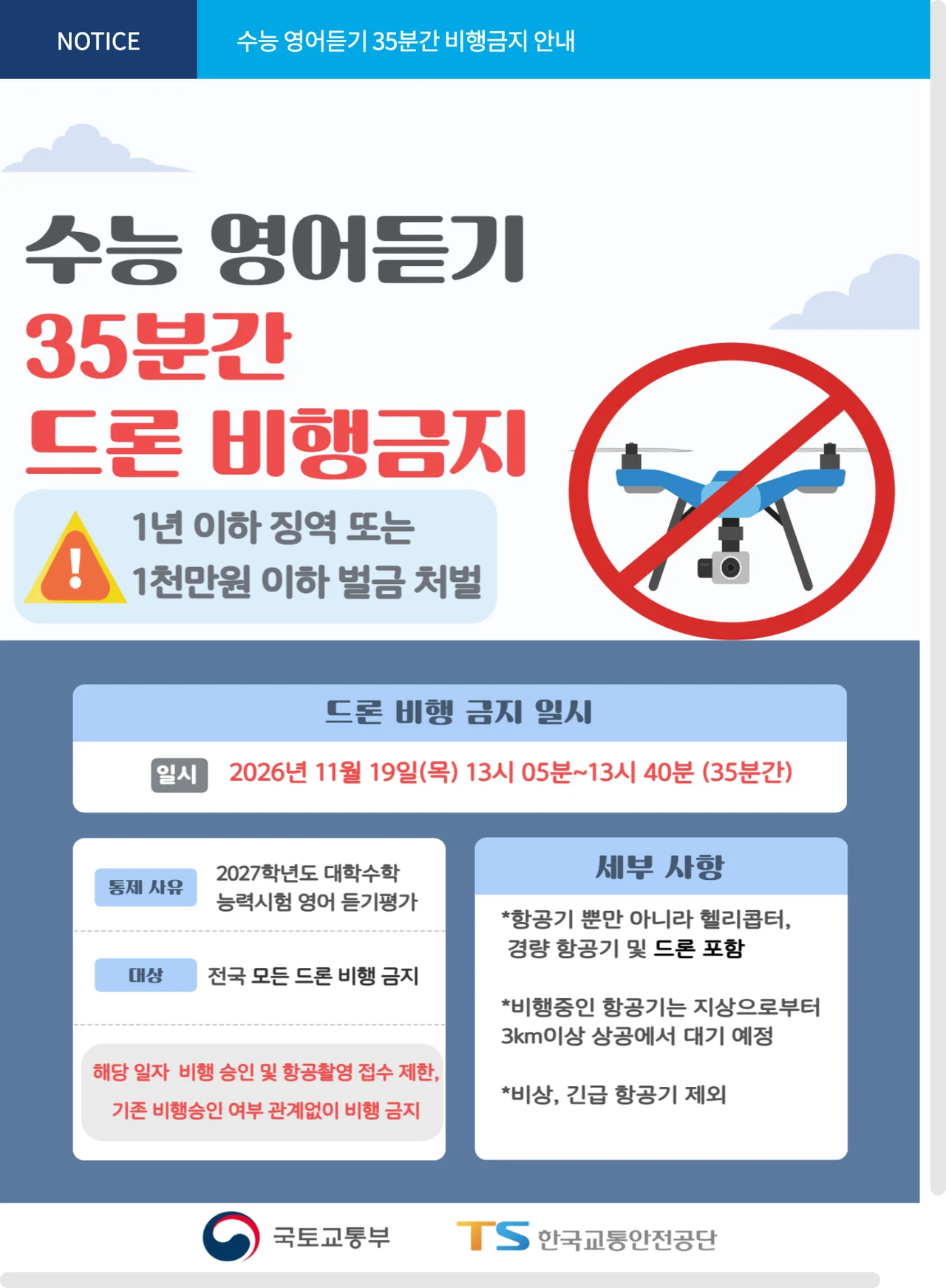
- No Exemptions for Pre-Approved Permits: MOLIT and the Korea Transportation Safety Authority (TS) have designated all of South Korea as a no-fly zone from 13:05 to 13:40 on November 19, suspending flight and aerial photography permit intake for that date. Even pilots who previously received flight approval are barred from flying during the 35-minute window. TS Drone One-Stop Civil Service
- Criminal Liability for Violations: According to the official TS notice, flying a drone during the restricted window carries criminal penalties of up to one year in prison or a fine of up to 10 million KRW. Travelers planning aerial photography in Jeju, Busan, or Gangwon should keep drones grounded throughout early afternoon on November 19.
Practical Travel Checklist for November 19 Afternoon Flyers
Passengers flying to, from, or within South Korea on Thursday afternoon, November 19, should complete four quick checks before heading to the airport.
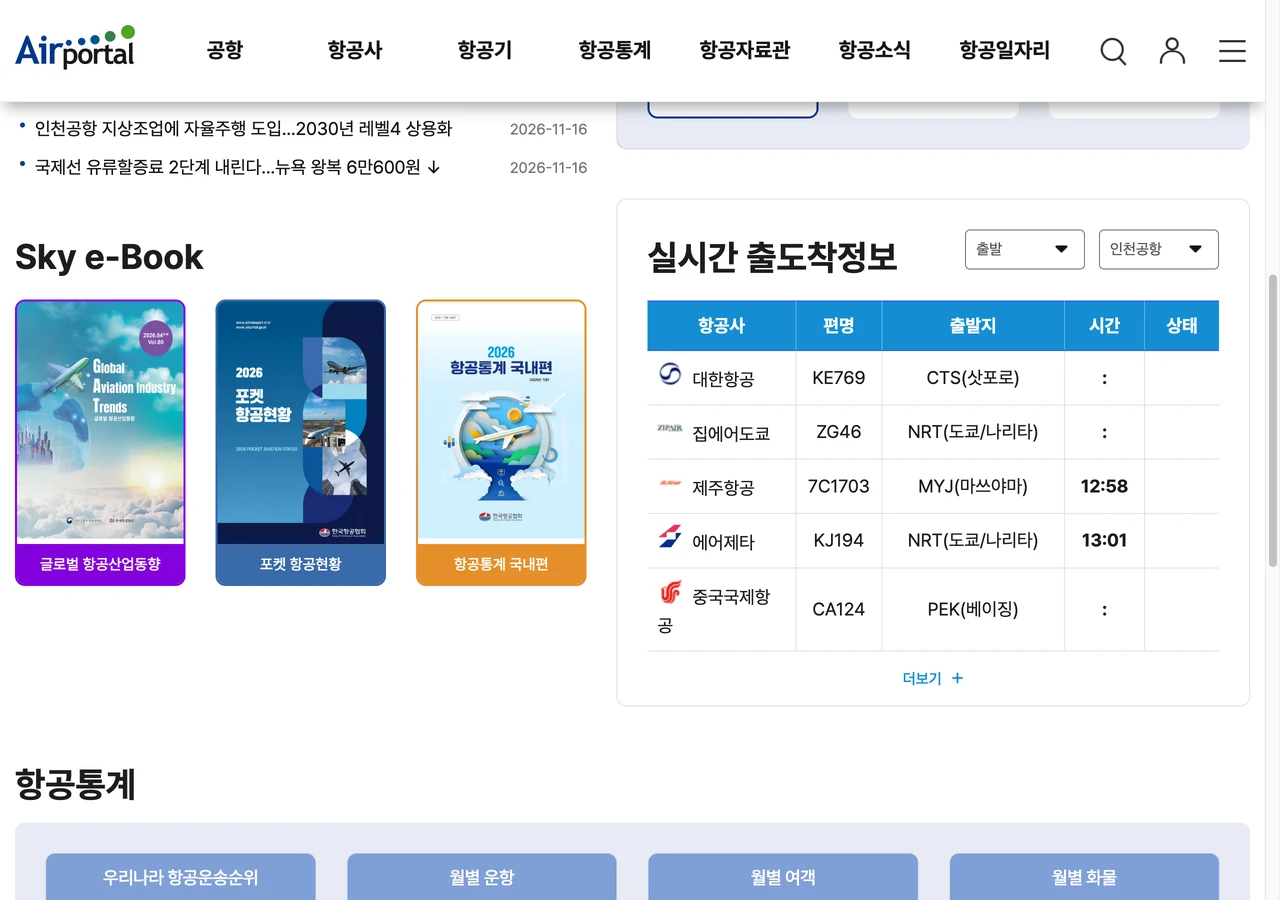
- Verify Live Times Directly with Your Airline or Airportal:
- If you booked through an online travel agency (OTA), carrier schedule-change notifications may arrive late or be filtered out. Anyone flying between 12:00 and 15:30 KST on November 19 should verify the latest departure or arrival time via the airline’s official website/app or South Korea’s official Airportal live flight tracker rather than relying on an older confirmation PDF. Aviation Information Portal (Airportal)
- Watch for Earlier Check-In and Baggage Drop Deadlines:
- Flights moved earlier to depart before 13:05 also have earlier check-in and bag-drop cutoffs. Plan to arrive at the airport based on your revised departure time (at least 2–3 hours ahead for international flights and 90 minutes for domestic flights), and factor in possible road congestion near urban test centers by taking rail transit such as AREX or the subway where available.
- Check Separate-Ticket Connections at ICN and GMP:
- Airborne holding above 3 km after 13:05 can delay afternoon arrivals into Incheon, Gimpo, and Jeju. If you booked separate tickets with a tight connection under two hours, confirm your airline’s contingency options in advance.
- Ask About Involuntary Schedule-Change Waivers Before Canceling:
- If an airspace-control rescheduling breaks an onward connection or makes your trip unworkable, contact your airline’s customer service before canceling manually to check eligibility for fee-free rebooking or a refund under involuntary schedule-change policies.
Official Sources and Verification Date
Verified: November 17, 2026. Control times, the count of 130 adjusted flights, holding altitude rules, and drone penalty provisions were confirmed directly from MOLIT’s press release and the Korea Transportation Safety Authority’s Drone One-Stop notice.
- MOLIT Official Press Release — CSAT 35-Minute Airspace Control (Nov 17, 2026)
- Korea Transportation Safety Authority (TS) — Drone One-Stop Civil Service
- Ministry of Land, Infrastructure and Transport & Korea Aviation Association — Airportal
Related News
- Incheon Airport Completes Phase 4 Expansion: Terminal 2 Opens Dec 3 with 106M Capacity, SmartPass & Layout Guide
- South Korea’s MOLIT Confirms 2026/2027 Winter Flight Schedule: Up to 5,353 Weekly International Flights and Major Slot Expansion at Regional Airports
- Straight from Incheon to Jeju, now through the winter: Jeju Air goes three times a week from November
Was this post helpful?

Leave a note
A question, a tip, or your own experience. No account needed.
Loading comments…